

If jaw soreness, clicking sounds or morning headaches have become part of your daily routine, you may be wondering whether braces could help. It’s a fair question, and the honest answer depends on what’s actually behind your symptoms. Here’s what our team at Balhoff Orthodontics in Lafayette wants you to know before you decide anything.
What Is TMJ Disorder?
TMJ stands for the temporomandibular joint, the small but hardworking hinge that connects your lower jaw to your skull just in front of each ear. When this joint or the muscles around it become painful or stop working smoothly, the condition is called TMD (temporomandibular disorder). Most people simply call it TMJ.
Common symptoms include:
- Persistent jaw soreness or tenderness
- Clicking, popping or grating sounds when opening the mouth
- Frequent headaches, especially around the temples
- Earaches or ringing in the ears
- Limited jaw movement or a feeling of the jaw “locking”
- Facial muscle fatigue
The TMJ is a complex structure involving muscles, ligaments, cartilage and a small cushioning disc. Because so many parts work together, TMD can have many causes, including clenching or grinding, stress, arthritis, injury and muscle tension.
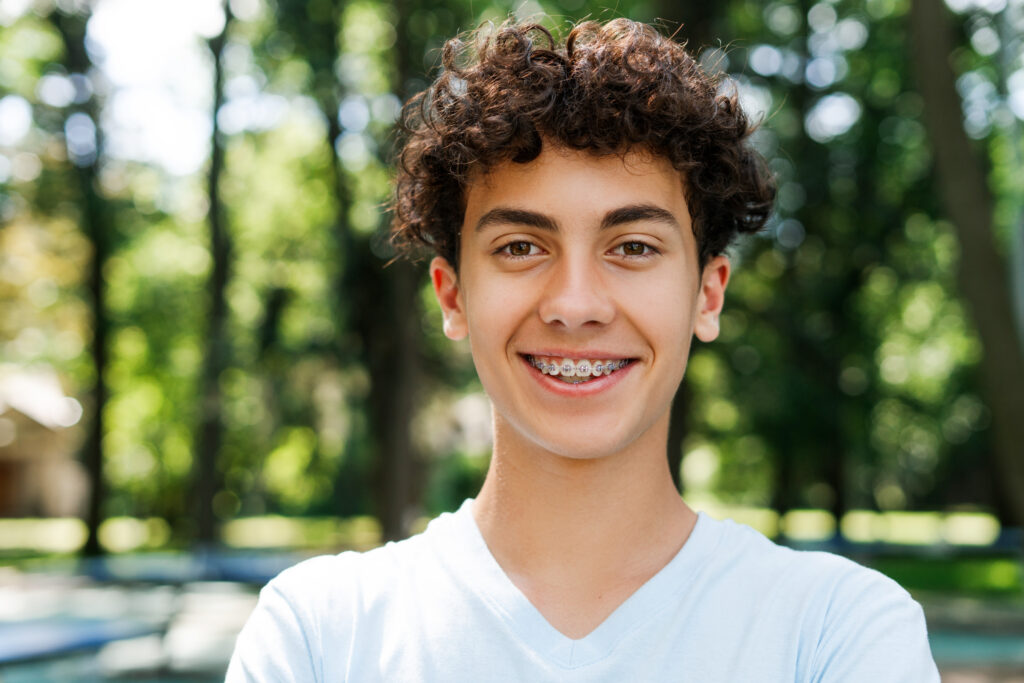
Can Braces Help TMJ?
Braces are not a treatment for TMJ disorders. The National Institute of Dental and Craniofacial Research notes that treatments that change the bite, including orthodontics, do not help TMD. Most TMJ symptoms improve with simple, conservative care instead.
What braces do is correct how your teeth and jaws fit together. If you have a bite problem worth fixing for its own sake, like a crossbite or a deep overbite, orthodontic treatment corrects it. It just shouldn’t be sold to you as a cure for jaw pain.
That’s why Dr. Balhoff looks at your jaw joints and muscles, not just your teeth, during an evaluation. If jaw discomfort is your main concern, you’ll get a straight answer about what orthodontics can and can’t do and where to turn for the right kind of care.
How Bite Problems and Jaw Discomfort Are Related
It’s easy to assume a crooked bite causes jaw pain, and for years that was a common belief. Today, research points to a mix of causes instead. Many people with bite problems never have jaw pain, and many people with TMD have well-aligned teeth.
That said, bite problems are still worth correcting for the health of your teeth. Common ones include:
- Overbite: Upper teeth overlap the lower teeth too much
- Underbite: Lower teeth sit in front of the upper teeth
- Crossbite: Some upper teeth sit inside the lower teeth when you bite down
- Open bite: Front or side teeth don’t touch when you close your mouth
Left alone, these issues can wear teeth unevenly and make chewing less efficient. Our post on addressing bite problems covers why they matter in more detail.
Can Braces Cause TMJ?
This is a common worry, especially for parents. Studies have not found that orthodontic treatment causes TMJ disorders. You can expect mild soreness for a few days after braces go on and after adjustments as your teeth start to move. That tenderness is normal and temporary, and it’s different from TMD.
If you already have jaw symptoms, let us know before treatment starts. Dr. Balhoff can plan around them, and our team will keep an eye on your comfort at each visit.
Managing Jaw Comfort During Treatment
Whether you have TMJ symptoms or just a sore jaw after an adjustment, a few simple habits can help:
- Stick to softer foods for a few days after adjustments
- Cut food into small pieces and skip very hard or chewy foods
- Use a warm compress on sore jaw muscles
- Notice if you clench or rest your teeth together during the day, and let your jaw relax
- Take over-the-counter pain relievers as directed if you need them
- Tell our team if jaw pain is severe or doesn’t fade after a few days
Common TMJ Treatment Options
Most TMJ care starts simple and reversible. Here’s how the common options compare:
| Option | Best For | Where It Fits |
|---|---|---|
| Self-care | Mild flare-ups and sore muscles | Usually the first step |
| Nightguards or splints | Nighttime grinding and clenching | Common early option that protects teeth |
| Physical therapy | Muscle tension and limited jaw movement | Often paired with other care |
| Medications | Short-term pain and inflammation | As directed by your doctor or dentist |
| Orthodontic treatment | Correcting a bite problem | Not a treatment for TMJ on its own |
| Surgery | Severe joint problems | Rare, a last resort after other care |
Nightguards and splints are often a helpful first step for patients dealing with nighttime grinding. Think of them as protective gear for your teeth while other care does its work.
Physical therapy pairs well with self-care when muscle tension is a major factor. Stretching, posture work and targeted jaw exercises can ease stiffness and improve movement.
Surgery is rarely recommended. It’s typically considered only when severe joint problems haven’t responded to simpler treatment, and it’s worth getting a second opinion first.
When to Get an Orthodontic Evaluation
It makes sense to see an orthodontist if you notice signs of a bite problem, like teeth that hit unevenly, a bite that feels off when you close or crowding and shifting teeth. It’s also worth mentioning any jaw symptoms if you’re considering braces or Invisalign clear aligners, so they’re part of the plan from day one.
If your main symptoms are jaw pain, locking or headaches without an obvious bite issue, start with your dentist or physician. They can rule out other causes, recommend care and refer you if your bite needs attention.
Adults who are weighing treatment for their bite can learn more about braces and aligners for adults at our practice.
Frequently Asked Questions About Braces and TMJ
Can braces fix TMJ?
No. Braces aren’t a treatment for TMJ disorders. They correct bite problems, which is worth doing for the health of your teeth, but most TMJ symptoms improve with conservative care like soft foods, heat or cold and jaw exercises.
Can braces make TMJ worse?
Studies have not found that braces cause TMJ disorders, and mild soreness after adjustments is normal. Changing the bite specifically to treat TMD isn’t recommended, though, because it doesn’t help and can sometimes make symptoms worse. If you already have jaw symptoms, tell your orthodontist before treatment starts.
Can Invisalign help with jaw pain?
Invisalign corrects tooth and bite alignment, the same goal as braces, so it isn’t a treatment for jaw pain. If you have a bite problem worth correcting, aligners may be an option. If jaw pain is your main concern, start with conservative care and talk with your dentist.
What kind of doctor should I see for TMJ?
Start with your dentist or physician, who can check for common causes and recommend conservative care. Depending on what they find, you may be referred to a physical therapist for muscle tension, an orthodontist for a bite problem or an oral surgeon for rare joint problems.
Is jaw clicking a reason to see an orthodontist?
Jaw clicking on its own is common and often harmless when there’s no pain or locking. If clicking comes with pain or limited movement, see your dentist first. If your bite also feels off, an orthodontic evaluation can check whether a bite problem needs correcting.
Is TMJ a chronic condition?
For some people it can be, but many TMJ problems are short-lived and improve with simple care. When symptoms last, ongoing management can usually keep them under control.
Get a Straight Answer About Your Bite
If jaw discomfort or an uneven bite has you wondering what to do next, you don’t have to keep guessing. Schedule a free consultation at our Lafayette office, and Dr. Balhoff will look at your bite and jaw and tell you honestly whether orthodontic treatment makes sense for you.